Showing posts with label writing. Show all posts

Tuesday, April 10, 2012

The Legacy of David Foster Wallace


Last week saw the arrival of The Legacy of David Foster Wallace, a wonderful collection of essays by Wallace critics, friends and colleagues. My piece in the collection, "Becoming Yourself: David Foster Wallace and the Afterlife of Reception," considered Wallace's legacy through his communities of readership on Amazon and I feel very lucky to be in such august company. For example, my essay is nestled between Dave Eggers and Jonathan Franzen!


Here's the full list of contributors:

Samuel Cohen (co-editor)
Don DeLillo
Dave Eggers
Ed Finn
Kathleen Fitzpatrick
Jonathan Franzen
Paul Giles
Heather Houser
Lee Konstantinou (co-editor)
David Lipsky
Rick Moody
Ira B. Nadel
Michael Pietsch
Josh Roiland
George Saunders
Molly Schwartzburg

Thanks very much to Lee and Sam for including me!

Sunday, October 30, 2011

Multitasking

It's been a busy month around here. I spent a fantastic week visiting the New America Foundation in DC and getting to know the people behind ASU's Future Tense partnership with NAF and Slate Magazine. There has been a lot of action back at the office too, and I'll be posting shortly about my upcoming trip to Emory. But for now I wanted to mention that I wrote up a short post for Open Culture last week to promote another ASU project, the very cool 10,000 Solutions. Check it out and share your bright idea!

Friday, September 16, 2011

Pamphlet #3

I'm very excited to announce that a version of my essay on David Foster Wallace has just been published online as the Stanford Literary Lab's third pamphlet. Here's the lead-in:

If there is one thing to be learned from David Foster Wallace, it is that cultural transmission is a tricky game. This was a problem Wallace confronted as a literary professional, a university-based writer during what Mark McGurl has called the Program Era. But it was also a philosophical issue he grappled with on a deep level as he struggled to combat his own loneliness through writing. To really study this question we need to look beyond the symbolic markets of prestige to the real market, the site of mass literary consumption, where authors succeed or fail based on their ability to speak to that most diverse and complicated of readerships: the general public. Unless we study what I call the social lives of books, we make the mistake of keeping literature in the same ascetic laboratory that Wallace tried to break out of with his intense authorial focus on popular culture, mass media, and everyday life.

Saturday, August 13, 2011

Writing in the Real World

It's been a summer of major changes in my life: completing grad school and moving on to my first job as a fellow at Arizona State University. As I adjust to a new position where I am "doing" almost as much as I am "thinking" (for a very word-based, university definition of doing), the impossible has occurred. I've begun to miss the abundant time I used to spend just sitting at the keyboard, writing. And think about writing. And fiddling.

I still do a fair amount of sitting and fiddling in the new job, of course, but my full agenda there does not include any special time for research. There is no gilt-edged appointment in my office Outlook calendar. I need to make that time myself, and I've begun to wish I was a faster writer. I mean, I'm fast enough at drafting proposals, emails and memos, but I don't have the prodigious speed that some academics seem to have for polishing off whole essays in an evening. I can barely read whole essays in an evening.

So my ambitions for this year are to practice the arts of making time and of thinking through problems on the go. It's dawned on me that my new slate of responsibilities is not a temporary condition, and that the period of graduate navel-gazing is done forever.

The positive side of this new reality is that I am actually starting to enjoy working on my own stuff once again. It's still a challenge of will to revise dissertation work for publication, but I am really starting to look forward to some new projects and fresh directions. Who knows, maybe I'll even put more time into this blog?

Tuesday, April 19, 2011

Nearing the Finish Line

I just sent off the last new chapter that I'll be writing for this dissertation to my committee. What remains is an introduction and a lot of revision, but it's very exciting to be approaching the end of a long, lonely road.

The chapter looks at two younger writers, David Foster Wallace and Junot Díaz, and argues that they both have carved out special positions for themselves through style. Each engages with the idea of the "nerd," which is a figure I've had trouble finding a lot of secondary literature on. There's some overlap with fans and media studies work on online communities, but the nerd is different, and it's a word Díaz in particular has used to describe himself and his work. What's interesting is that the two writers started with the same basic objection to the problems of what Wallace calls "Standard Written English" and came up with radically different solutions. Wallace pushed the envelope with footnotes and postmodern stylistic games; Díaz broke new ground in integrating English, Spanish, and many other cultural and genre dialects, making what he calls the bedrock fact of "unintelligibility" a central part of his fiction.

Thursday, October 14, 2010

Things are Cooking at First Person

I’m happy to share news of some exciting developments on the First Person thread over at the electronic book review.

First, we published a great riposte by Daniel Worden to Sean O’Sullivan’s essay on Deadwood, one of my favorite shows. The original essay appeared in Third Person and discussed the inherent tension between the plot demands of the television episode and the television series. Worden responded by thinking about the different definitions of necessity at work in the show, including the crossover between the narratological manifest destiny of a canceled season and the kind that drove all those characters to settle the deadly Black Hills of South Dakota.

Second, and ongoing, we’re running a series of entries drawn from the Critical Code Studies Working Group. The group took on the challenge of interpreting software not just as the mechanism for all of our new digital texts and toys, but as text itself. The conversation is a virtual who’s who of software studies, and I’m very excited to be editing its ebr instantiation. I find the subject fascinating and this is a great experiment in new models for digital scholarship. In Mark Marino's introduction and the Week 1 discussion participants tried to hammer out some basic definitions and discussed readings of the infamous Anna Kournikova worm.

Friday, September 17, 2010

Franzen on Oprah

As a follow-up to my last post I was planning to talk a little more about the images I posted there. But before I get to that, I need to digest the latest wrinkle in this canon conflict--Franzen's Freedom has been named the latest Oprah's Book Club pick! (Of course I learned of this from a Barnes and Noble email.) This is a bit shocking because of the awkward kerfuffle that happened last time Oprah picked a Franzen novel, when the author said some disparaging things about the whole idea and got himself uninvited.

According to Reuters: "This time, Winfrey said she sent Franzen a note asking for his permission to feature his latest novel 'because we have a little history.'" I wonder if that means Franzen will appear on the show? If so, it's interesting to speculate what's changed in the literary world since 2001. My off-the-cuff guess would be that we're seeing a kind of flattening of the literary universe as professional critics thin their ranks and the publishing industry struggles to adapt to new realities. But on the other hand, it's entirely possible that Franzen won't go on the show, and that Oprah's taking the high road (as in both moral and -brow) on her own.

All of this circles back to the 'Franzenfreude' debate. The same things that presumably attracted Oprah to the book: its themes of American families, love and the struggle for a new domesticity (or so I hear, not having read it yet) are the same things that make the novel appealing to more than just the 'male readers' Franzen was so worried about losing during his previous Oprah spat. And of course these themes would (so critics argue) condemn Franzen to chick-lit middlebrow status if he happened to be a woman.

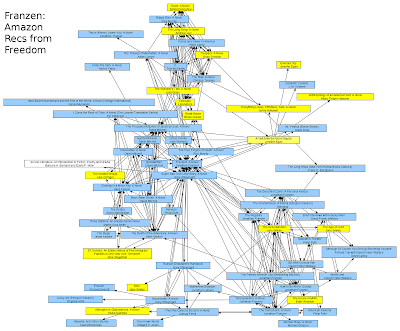
What we can glean from the images I posted previously is that Franzen really is successful at breaking out of the 'challenging young novelist' box. Unlike, say, David Foster Wallace (whom I'm working on right now), Franzen's books are avenues of exchange for readers of Jane Smiley, Jennifer Egan, David Mitchell, and a host of other writers of both sexes (though, it must be said, more men than women). Oprah's latest pick proves what we see in the images below: Franzen has managed to snag the ring of elite literary prestige while still appealing to diverse audiences. His books lead readers to varied literary clusters, not just to more Franzen. And his links to the canon-spanning roster of previous Oprah selections will only proliferate in the coming months.

Friday, September 3, 2010

Gender Bias in Reviews

I was fascinated to read an analysis Slate's DoubleX staff ran yesterday about gender bias in New York Times book reviews. They discovered that there is a significant slant towards men getting reviewed (and men doing the reviewing), particularly for authors who get the coveted double-coverage treatment (a review in the newspaper as well as one in the weekend Book Review).

One question they pose is about contextualizing writers—would Nick Hornby be a chick-lit writer if he was female? They say: “Our tools are not fine-tuned enough to answer these questions.”

As a former Slatester myself and a current grad student who's working in precisely this area (not on gender, per se, but on reviews, how writers become famous and how books live their own lives online), I have some tools I can bring to the table.

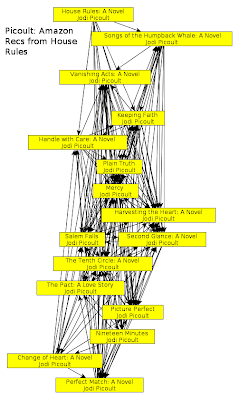
One of the reasons this stuff is hard to pin down is that the literary marketplace is vast, fluid, and poorly documented. The New York Times bestseller list is something of a black box itself, so why not take a look inside some other black boxes to see what distinguishes authors? This is the logic that has led me to spend some serious time looking at Amazon (after all, the world's largest bookseller) to see how authors get contextualized there. I decided to see what the gender breakdown is for books that are recommended1 from the main subjects of the Slate article: Franzen, Hornby, Weiner and Picoult (who kicked off the debate with an angry comment about Franzen's rave in the Times, if I recall correctly).

The results are shocking. See below: boys in blue, girls in yellow (click on the thumbnails to see larger images).2 Yes, Franzen and Hornby are linked to a lot more men than women—not too surprising. Weiner is linked almost exclusively to women—again, not a huge surprise. But take a look at Picoult—she is a literary island unto herself, according to the Amazon recommendation engines. This is very rare in my research, and I think indicates an author who's distinctive in a stylistically interior way—her books lead readers to more of her books, not to things outside the Picoult universe.

I did this quickly so I might have gotten a gender wrong somewhere or messed up a book network somehow, but as a quick sketch of the differences between Franzen, Hornby, Weiner and Picoult, I think this is quite interesting. (Or at least the perceived differences, which in the literary world are more or less the whole of reality anyway). I don't have a strong opinion in the debate; it seems clear that more men than women are reviewed in the Times, while it's almost certainly true that many more women than men read novels. But as some comments on the Slate article pointed out, gender bias doesn't happen in a vacuum--readers, authors and critics are all players in the same complicated literary game.




1. I look at these recommendations because I think they're one of our best models for what books people actually buy together. In practice books connected this way tend to jump the boring categories like genre and author and link together in much more idiosyncratic ways. Obviously Amazon plays with these results...but they're always trying to sell more books, and they're pretty good at it, so I use the recommendations as a best approximation of the marketplace.

2. "What am I looking at?" The nodes here are books on Amazon, and the arrows connecting them are recommendations from one book page to another. These results represent the first ten “Customers who bought X also bought Y" recommendations for each book, starting with each writer's most recent fiction publication (Freedom, Juliet, Naked, Fly Away Home and House Rules, respectively).

Wednesday, September 23, 2009

Author Soundtrack

I feel like the soundtrack has changed recently around here from the mellow tunes of summer so something more purposeful, something with an actual beat. This is good news for the dissertation project, which has taken on steam again after a summer of revising, paper-pushing and sustained attention to the vodka-sequestering properties of watermelon lemonade.

With soundtracks in mind I was delighted to come across a reference on the Pynchon-L mailing list, wherein I occasionally lurk, to this. Music plays a big role in Pynchon's work, and he took the delightful step of writing up a playlist to go along with his new novel, Inherent Vice. The list mingles real 1960s artists with a few of his own creations, like Carmine and the Cal-Zones.

Tripping down the shuffle soon, I hope: A return to Infinite Jest and Infinite Summer; some pithy definitions of postmodernism (not mine); and an update on networks both allusive and recommendational.

Wednesday, July 22, 2009

Genre Fiction & The Relentless Undead

One of the interesting questions at play in my dissertation is the way treat genre writers differently from "real" writers. Authors like Michael Chabon, Thomas Pynchon and Cormac McCarthy straddle the boundaries between "literary" fiction and different genre styles in interesting ways. There's a great article in this weeks Sunday Times Magazine discussing Jack Vance, an apparently seminal genre writer whom I never read in all my years as a genre bookworm. According to the article Vance (and many other genre writers, I think) approached fiction as a job and a career as much as an art form. Vance and his wife would travel to exotic places, find a cheap hotel, and draft a new novel together. Nice life! That kind of commercial focus is much less acceptable among "serious" novelists.

While we're on the subject, I will now publicly admit that I recently read Pride and Prejudice and Zombies, probably the most violent fictional assault to date on the barriers dividing highbrow and pulp. My wife quite accurately calls it an "abomination." I think she's serious, but when I repeat it, I mean it in a good way. I would like to share my favorite paragraph here. See if you can tell what was changed from the original Austen:

But why Mr. Darcy came so often to the Parsonage, it was more difficult to understand. It could not be for society, as he frequently sat there ten minutes together without opening his lips; and when he did speak, it seemed the effect of necessity rather than of choice. He seldom appeared really animated, even at the sight of Mrs. Collins gnawing upon her own hand. What remained of Charlotte would liked to have believed this change the effect of love, and the object of that love her friend Eliza. She watched him whenever they were at Rosings, and whenever he came to Hunsford; but without much success, for her thoughts often wandered to other subjects, such as the warm, succulent sensation of biting into a fresh brain. Mr. Darcy certainly looked at her friend a great deal, but the expression of that look was disputable. It was an earnest, steadfast gaze, but she often doubted whether there were much admiration in it, and sometimes it seemed nothing but absence of mind. And upon imagining Mr. Darcy's mind, her thoughts would again turn to the subject of chewing on his salty, cauliflower-like brain.

Tuesday, April 7, 2009

Reading : Material Culture :: Chicken : Egg

A few weeks ago Matthew Wilkens posed a question reaching to the heart of my interdisciplinary project:

A question I'm sure you've already gotten many times and likely will many more in the future: To what extent is this kind of work meaningfully understood under the rubric "literary criticism" at all, as opposed to literary-themed sociology and/or the business of literature? ... [I]t seems to me that the line between the English department and the sociology department or the business school probably falls somewhere around whether you want to explain the features of particular texts by reference to social/cultural/economic factors, or explain socioeconomic effects by way of book-related networks. So ... which is it?


As I replied then, the answer is a bit of both, but I think I ought to expand on that a little more. I am particularly interested in literature as a social phenomenon, and not just an individual experience. Reading can have extremely powerful transformative effects on the individual, of course, and those changes can impact whole categories of interaction and cultural thought. I believe that the authors who have been most successful both commercially and critically are particularly gifted at recasting the operations of our reading minds. Not only does reading Pynchon or Morrison enlighten, entertain and at times frustrate, it also changes how we think about fundamental planks in the social structures holding us together, like ideas of race or communication.

That said, I hasten to add that I don't think of this project as an economic story or a business school case study. I don't think these authors set out to get rich and decided that writing novels was the way to do it. Nor do I believe that they are motivated by a quest for recognition or a conscious desire to change how people think, though I do think those motivations are intrinsic to almost all of us to some degree.

Instead, I think of this as a literary approach to the question of reading. If the humanities must show their worth, there is no better way to do it than to reveal the structures of connection and thought that define us as cultural beings, to show how those structures are changing, and to consider the many and expanding ways in which we read and write the cultural landscape. Contemporary literature is an exciting, complicated field to work on, and it takes an interdisciplinary approach to map out the connections between different kinds of cultural authority, changing modes of readership/criticism/authorship and the abiding power of literature to convey human experience at a deeper level than any other medium.

In short, I don't think there's a one-directional causal force at work here. These ideational networks of texts, ideas and people are messy, provisional things that generally influence us in subtle, if pervasive, ways. I'll be doing some close reading, and also trying to think about how others do their close reading, and how we read and evaluate culture collectively.

Tuesday, March 3, 2009

Mapping Literature: Cultural Capital in the Digital Era

I've been making a lot of progress since I last posted here and I think ti's time for a more complete description of my dissertation project (yes, be still your racing hearts). Here's the overview:

In the past fifty years the world of literary publication has experienced a continual revolution of new social structures, business models and textual media. The growth of university writing programs, the birth of the mass-market paperback, the corporate consolidation of publishing houses, the emergence of national mega-bookstores, and the dominance of the Internet are some of the major milestones in this saga. Yet by and large literary critics still approach books published today with the same set of cultural and scholarly expectations as they do works that appeared a century ago. The goal of this dissertation is two-fold: first, to map out these new and still-evolving ecologies of reading and writing in a digital era; second, to articulate a new model for the engines and pathways of literary success in its many contemporary forms.

The structure of the dissertation will address these two goals simultaneously by working through a series of specific examples of contemporary literary success using a case-study model. The relationships between new literary ecologies and authorial success are related in complex and interdependent ways, and the use of diverse case studies will allow us to employ information from a variety of different sources, including literary close readings, analyses of critical responses, and a variety of non-literary sources, such as consumer reviews, citation indexes, sales information, interviews, etc. Many of these evidentiary sources offer a glimpse into parts of our lives as readers that were rarely accessible in the past: book associations (i.e. the “customers who bought this book also bought these other books” feature), customer ratings, reviews, and conversations, and used book availability (as a comparative index of a work’s staying power), for example. It is also important to recognize the roles that many actors play in the process, from literary agents to publicity managers and from booksellers to professional critics. I will also conduct interviews with representatives from these groups in order to map out their varying positions in terms of cultural production. Each case study will face the challenge of integrating disparate empirical evidence with textual readings.

The value of this project lies in the attempt to shift the playing field of literary studies, however incrementally, to adapt to a changing media reality. As the impact of capitalism on cultural life and the world of the university becomes ever more powerful, any honest study of contemporary literature must address the ways in which cultural values and economic interests interact to help determine what, how, and why we read. This project will uncover some of the ways in which these changes affect not just the production of literature but its life after publication. The authors profiled here have all succeeded (or failed interestingly) in creating ideational networks with their books, leading readers to other books and to new ideas, dialogs, and writings of their own. As more readers become critics and writers, the traditional boundaries of publishing are crumbling.1 I will argue for a new understanding of literary fame and the role of authorship in an increasingly collaborative, engaged society, where capitalist consumption increasingly equals cultural production. In this landscape the critical term cultural capital must be overhauled to incorporate the role of ideational networks and the distributed power of millions of cultural producers/consumers. The growing sophistication of cultural production is leading to new scarcities and abundances driven by the resources and capacities of this cultural consumer, a figure now actively engaged in the construction and expansion of ideational networks and in redefining literary production.

Friday, January 16, 2009

Pynchon and the Paranoid Sublime

It seems like the holidays happened ages ago, but it's only been two weeks since we entered 2009 and a little less than that since I got back on the dissertation trail. I spent most of my time since the last posting working on a revised dissertation proposal. Once I ascertain that my committee has, in fact, approved that, I'll post some details here.

The other project I've been working on and just completed is a revised draft of a paper on Pynchon and cultural capital in the digital era. I'm arguing that Pynchon's unique success as an author is connected to both his postmodern anonymity and something I'm calling the paranoid sublime. This combination has helped make Pynchon such a critical and commercial success, allowing me to use his career as a model for exploring the new cultural capital. I'm hoping to submit it for publication soon.

The Pynchon paper will eventually turn into one of my chapters, so I'm hoping to work through some of my ideas in this shorter form first.

Thursday, November 6, 2008

Dissertation Update #1: Wherein the Expedition sets off in Crisp Morning Sunshine

I'm going to try a little motivational experiment here by writing about my progress on the dissertation. I don't know how frequently I'll be doing this but I hope at least weekly.

Right now my topic, broadly, is the question of cultural capital in an era of digital literacy. How are ecologies of reading and writing evolving online and what does that mean for authorial fame and fortune? I have many more ideas but I'll save them for future posts (and more mulling).

The reason I'm writing now is to share the geeky thrill I felt when I picked up a stack of books from the ASU library today. It's been a bit of a struggle getting access and requesting books from a new institution where I have no official status, and it's a relief to know that I can still track down the books I need.

I'll put texts up in LibraryThing as I tackle them. Time to get reading!

Wednesday, November 5, 2008

Zap!

I'm downsizing. My long-running blog Parlay began as a personal experiment, evolved into a largely unsuccessful promotional vehicle, dawdled along as a lifeless bundle of digital flotsam, and now has finally been put to rest. Maybe with just one garden of words to tend I can do a better job. Http://www.edfinn.net will now point here.

I hope to write here about my research, the looming dissertation (more on that in a separate post), and items of more general interest.

Thursday, April 17, 2008

Digital Fiction

I just came across a post on BoingBoing to some new digital fiction put together by Penguin. I'm excited about this for two reasons. First of all, each of the pieces (there are six in all) experiments with a different digital form. Second, a major publishing house is demonstrating interest in digital literature--great news for someone who's hoping to write, and write about, some digital lit himself one day.

Monday, April 7, 2008

Out of the Cold

It's been a long, dark winter of exam preparation, stressed-out reading, and gallons of tea. Parts of it were a lot of fun, and I've now read a lot of books that I would surely have taken years to finish otherwise. But: I am glad to be finished.

The sun is shining, the requisite post-Orals sloth and dazedness are wearing off, and it's time to get going on some new projects. I have a few work-related tasks to grapple with, and I have a paper to polish. Then, on to dissertation planning. Time to get back to work!

Tuesday, April 17, 2007

Open Culture: Another Blog Life

My friend Dan has invited me to start contributing to Open Culture, his awesome blog and compendium of all things podcastic, free and/or cultural. Check out my first post!

Wednesday, March 7, 2007

Taking the Weber show on the road

How time flies! I can't believe it's been a month since my last post. I'll try and do a little better. One reason things have been so busy for me is that I finally completed a draft of a seminar paper that has been steadily growing into something bigger.

On Monday I submitted an abstract based on this evolving opus to a conference at UCLA. The theme of the 18th Annual Southland Graduate Student Conference is "Synthetics" and the paper I've been working on connects Max Weber to contemporary questions of identity and production, so this seems like the perfect venue to work on my ideas. Here's my abstract:

The Networked Shell: Max Weber and the Ethic of Work in the Digital Era

In The Protestant Ethic and the Spirit of Capitalism, Max Weber twice used a metaphor that has become a touchstone in cultural analysis for the past century: the “iron cage” of capitalism in which we have all been trapped. The Puritan overtones of this translation represent a semantic intervention by Weber’s first American translator, Talcott Parsons. In his translation of the work Peter Baehr makes a convincing argument that this iconic metaphor should in fact be translated from the German (stahlhartes Gehäuse) as the “shell as hard as steel.” In a close reading of Weber’s original text I will flesh out this reading: the “shell as hard as steel” is an organic, protective carapace that shields and defines as much as it limits and confines its inhabitant. I will follow the metaphor of the shell as hard as steel from Weber to the darkness of World War II and the intellectual and technological revolution that sprang from its ashes. From there I will pick up the story of how cybernetics and post-war military-industrial research blended with the 1960s counterculture to create the network society of the 1980s and 1990s and, more recently, our own synthetic cultures of virtual production. By following its thread from Max Weber through the twentieth century, I hope to create an interpretive foundation on which to answer a very Weberian question: what is the ethic of work in the digital era? What does it mean to be an individual trapped/integrated/liberated by the networked shell of contemporary capitalism?


We'll see if they like it.

Wednesday, February 7, 2007

How Fred Writes

I'm about to sit in on a talk in the series How I Write at the Stanford Writing Center. Tonight's speaker is Fred Turner, who wrote a great book on the emergence of the digital counterculture in the 1960s and beyond.

I'm particularly interested in what he has to say about his writing process since he also lived a life in journalism before returning to grad school and academia. His time in journalism was much more serious and successful...but I'm hoping the experience will still translate.

Oh, wow: I just discovered that the "How I Write" website has an amazing archive of audio and video! Very neat.